FARMING AMERICA
SINCE 1988
About Us
Owner/Operator: Joe Ayars
Operator/Fabricator: Jon Ayars
Ayars Farms is located in Salem, NJ and has been a multi generation farm on my mother's side of the family skipping her generation. My grandfather was a dairy, grain and vegetable farmer all of his life. The dairy was sold in the mid 60's so I missed the pleasure of milking twice a day everyday. He continued to raise grain and some sod in the late 70's and into the 80's. While growing up I worked by his side learning the business. In 1988 I raised my first crop on a field my grandparents owned, in 1989 I rented three farms and continued raising just soybeans for several years before diversifying into other crops and custom work. Today we farm in two different counties raising corn, wheat, soybeans and peas. In 1993 I bought my first combine, a Case IH 1640 and that was when I started custom combining for other area farmers. The business really grew from that point. In the mid 90's I purchased snow plows for our Steiger tractors and for approximately 20 years pushed snow for the county to keep busy during the winter months.
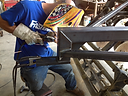
In 2007 my brother Jonathan joined the farm as a full time employee. He is 10 years younger than I am. Before he started full time he helped me out when he got done work and on weekends when I needed help. He is an excellent employee, aside from being a great operator of equipment, he is a natural at painting and fabricating. If we can't buy what we need, he builds it.
In the three decades that I've been farming for a living I have really seen the technology change and today we take advantage of any new piece of technology that enters our business with the confidence that it can keep the farm successful while raising yields and lowering input costs. Since 2006 we've been running GPS guidance on all of our tractors, satellites in space link up with receivers on the tractors and they steer our planting tractor with sub inch accuracy across an entire field. Once the operator enters the working width of the implement being pulled and determines the path in the field, the auto steer system then records it, takes over and steers the tractor back and forth across the field eliminating costly overlap of expensive seeds and fertilizers. It saves us hours of work, wear on equipment, fuel and operator fatigue as well allowing us to run longer each day covering more acres and being more productive.
Our combines run GPS for yield data and guidance. As the combines move through the field data such as yield and moisture are recorded in real time to site specific spots in the field which can later be analyzed. The yield maps show inconsistencies in the yields and can then help us correct them with fertilizer, lime, drainage and seed rates for crops in the following years. The yield map to the left shows over a 100 bushel difference per acre. Previously we would have only considered how the yield averaged across the entire field, now with the yield maps we can look at specific low yielding spots in the fields and determine why they may have yielded lower than the rest and come up with solutions to enhance the yields there next season.
With land being a farmers biggest asset we are very conscious about keeping it in a highly productive state. In 2013 we started having fields mapped with a Veris machine. From this machine we get a map of the field that will show where the different soil types are located. At that point each soil type is treated individually within the same field, the soil tests that are taken are marked with GPS points within each soil type so that we can come back for years and monitor fertility levels with incredible accuracy. PH and fertility levels are never constant across any field so with the data this machine records we are then able to variable rate expensive fertilizers and lime only to apply what is needed by the crop and not wasting product. Combining the Veris information with our yield maps we now can basically treat every acre as though it is its own separate field. The photo to the left is an example of one type of Veris set up and the map it can produce indicating the different soil types in one 35 acre field. Variable rate planting will be the next big technological step towards improving our yields, in 2013 on app. 1/3 of our acres we put that technology into use.
We practice many types of tillage on our farms, but close to half of our acres are no-tilled every year, it saves a tremendous amount of fuel and combined with the use of cover crops, nutrient management and variable rate applications of fertilizers run off of expensive chemicals and fertilizers are greatly reduced making the practice very environmentally friendly. Severely compacted areas are corrected with the use of a deep tillage ripper that helps enable crop roots to search more easily for nutrients and water. With the other half of our acres being vertically tilled ahead of the planters it helps to control weed growth and warm the soil in the spring to allow us to start planting sooner than our no-till acres. Vertical tillage isn't new but we employed the practice shortly after it was introduced to this area and believe the concept has more than paid for itself with increased yields and savings in time and fuel over other conventional tillage methods we used in the past.
Like all businesses we assume a large amout of risk and since we will forever be at the mercy of mother nature 100% of our grain crops are insured, it's expensive but provides us with peace of mind knowing that if a disaster strikes such as drought or abundant rainfall we have coverage to help ensure that the business will continue on. Aside from striving to raise better crops than we did the year before, we do a full range of custom work, from tillage to harvesting to help out other area farm operations.